OttoLearn offers a first college statistics course as interactive lessons. Today you can use the lessons in full without an account. Here is what you can use right now, what the account features add, and what your teacher sees if you join a class.
Opens lesson 1 of the statistics course. Nothing is asked of you.
With no account
Nothing to create and nothing to hand over.
Whole lessons, no account
You want to study tonight, not fill in a sign-up form.
Today you can read every lesson of the Introduction to Probability and Statistics course in full without an account: the explanations, the worked examples, the practice, the solutions.
Why You should be able to judge a course before you hand over anything. An account is for people who want the site to remember their progress.
Your answer is wrong, the screen says “Incorrect”, and you still do not know why.
You see which idea led you astray: in multiple-choice questions, a wrong choice comes with a short explanation of the slip behind it.
Why Feedback is most useful straight away and when it is about your reasoning. A mark with no reason only invites another guess.
Try it here · nothing is recorded
A survey asks people leaving a gym whether they exercise every week. Most say yes, and the report concludes that most people in the city exercise every week. What is the main problem?
Pick a wrong answer on purpose: the explanation changes with what you chose.
A new version of the problem whenever you want one
After the second try you remember the answer, not the method.
You can practise a method as often as you like: many practice problems are generated, so asking for another changes the numbers or the situation while the skill stays the same. Numerical answers are usually typed, not picked from a list.
Why Producing an answer is different from recognising one. Typing it, on a problem you have not seen, is closer to what a test will ask of you.
Try it here · nothing is recorded
Check an answer, then choose “Another problem”: the numbers change, the method does not.
Step-by-step help that steps back
A problem with several steps goes wrong somewhere and you cannot tell where.
You find the exact step where it went wrong: guided problems check each step as you go. In some later lessons a problem starts with you working alone, and the steps come back only if you ask.
Why Support helps while a method is new and gets in the way once you know it. So the lesson gives a lot at first and then leaves the work to you.
Try it here · nothing is recorded
A short one, to show the idea: each step is checked before the next appears.
Worked examples you attempt before you read
Reading a solution feels like understanding it, until the next problem.
You see which step you could not have done alone: the first example is solved in front of you; after that, the examples ask you to try first, and then the full solution appears with one click. No answer is required to see it.
Why We ask; we do not force. A box you must fill in before seeing a worked solution only teaches you to type anything.
Try it here · nothing is recorded
A bag holds 3 red and 5 blue marbles. One marble is drawn at random. What is the probability that it is not red?
Pause and write. Record your answer and reasoning on paper or in your notes before continuing. Even if you are unsure, committing your thinking helps you see what you understood and what you need to revisit.
Show Solution
There are 8 marbles and 3 are red, so the probability of red is 3/8. “Not red” is everything else: 1 − 3/8 = 5/8, or 0.625. Counting the 5 blue marbles directly gives the same 5/8, which is a good check.
Figures you can move
You can recite the formula for the mean and still not see what one extreme value does to it.
You see an idea happen: drag a data point and watch the mean follow, or draw sample after sample and see where the results pile up. The lessons have many figures like the one below.
Why Some ideas in statistics are about what happens in the long run, and no single picture shows that. A figure is most useful when you have a question to answer with it, so the one below starts with a question.
Try it here · nothing is recorded
Six homes sold for about three hundred thousand dollars and one for far more. Before you drag the orange dot back toward the others: which will move, the mean, the median, or both?
Mean x̄ = —Median = —Gap = —
Drag the orange dot left or right — or focus it and use the arrow keys. The mean (▲) follows
the moving observation; once it separates into an outlier, the median (◆) barely moves.
A warm-up on what the lesson builds on
You get lost in a new lesson because of something from three lessons ago.
You can check for a gap before the lesson needs it: near its start, each lesson lists what it relies on and asks a quick question about it. The feedback explains the idea you need.
Why A gap is easiest to fix before it is needed. Recalling an old idea is also one of the better ways to keep it.
The whole course laid out before you start
You find out what the course expects of you one week at a time.
You know from day one what “ready” means: every standard of the course is written out. A standard is one thing the course expects you to be able to do. They sit beside the schedule and a page that explains how grading works and why.
The z-table is in another tab, a PDF or the back of a book.
You look a value up where you are working: the z, t and chi-square tables sit in the lessons that introduce them, and some figures highlight the row and column you should be reading.
Why Reading a table is a skill you will be tested on, so it is practised where the problem is.
Practice aimed at one standard, and a practice test
Still being extended
The exam is next week and “review everything” is not a plan.
You see what you miss on a timed check: a short timed check on one course standard, then practice on only what you missed, then a fresh check. A practice test is a timed set like a midterm. Your attempts stay in your browser; for a signed-in student, an answer-free summary of one kind of check, the synthesis check, can update the private estimate. It covers most standards of the statistics course and is still being extended.
Why A check with no warm-up and no hints is the closest thing to the real test. It informs you and does not become a grade.
In development: six further kinds of question (answer on a graph, fill a table, sort items into groups, enter a formula, assemble a conclusion sentence, build a data set that fits a condition) are built and are not yet used in any lesson.
With the account features: through your teacher, for now
The features below come with an account. They are not on sale: a teacher who uses OttoLearn with a class can give a student access to them. Accounts and the AI features are still being tested, and a privacy assessment is not finished. There is nothing to do now: everything above works today with no account.
Each row opens: what it does, why, and sometimes a picture.
A map of where to work next
You have practised a lot and still cannot say which topics are solid.
What it does, and why
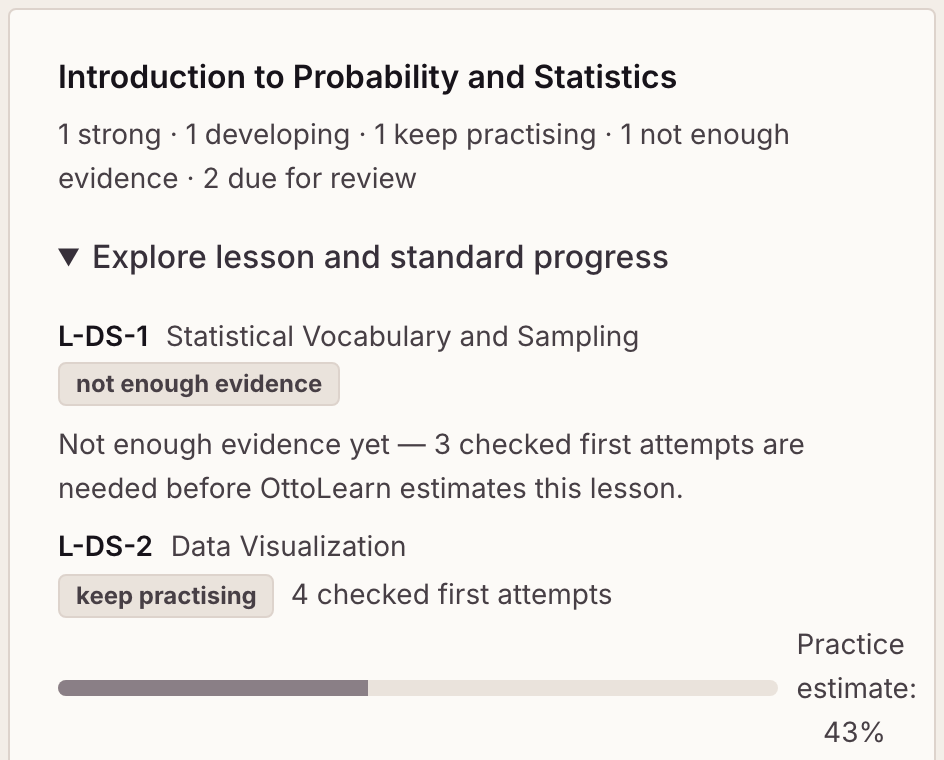
You see where to work next: your dashboard shows each lesson with an estimate built from your own practice, and how much evidence is behind it.
Why It is an estimate and it is labelled as one; it does not become a grade. Other students do not see it. If you join a class, the last section of this page says what your teacher sees.
Notice the label under each lesson and the count of checked first attempts: answers you committed to before any help. “L-DS-2” is a lesson’s code.
A fictional class: the names and numbers are invented. Tap or click a picture to see it at full size.
Review that comes back when it is due
You understood it in week 3. The exam is in week 8.
What it does, and why
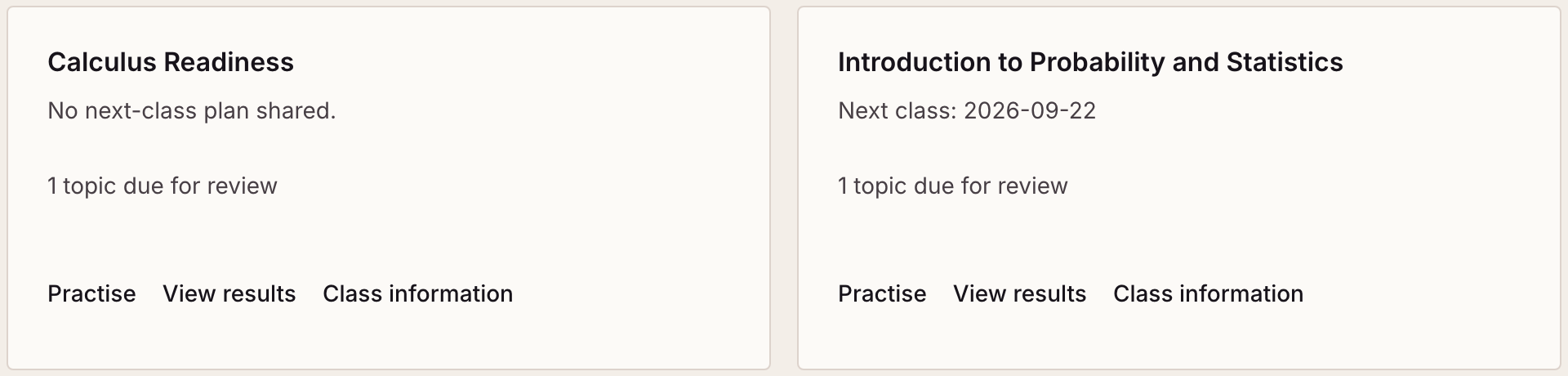
Earlier ideas come back on a schedule: the site brings them back as fresh problems, a few at a time, and sometimes mixes ideas that are easy to confuse so that you have to tell them apart.
Why Short returns spread over weeks follow how memory holds on to things. The alternative is cramming the night before.
Notice it counts what is due now, not everything you ever studied.
A fictional class: the names and numbers are invented. Tap or click a picture to see it at full size.
A next exercise chosen for you, in the time you have
Still being extended
You sit down with twenty minutes and spend five deciding what to work on.
What it does, and why
You can start without deciding what to study: choose a course and the site suggests an exercise, gives feedback and offers a fresh one. You tell it how many minutes you have each week and for a session. The site’s own guided practice currently covers three topics of the statistics course; for the others it points you to the practice inside the lesson.
Why Deciding what to study is work the site can take off your hands; doing the exercise is the part only you can do.
Explain it to Otto, the site’s AI guide
You can follow the idea. Can you explain it without the page in front of you?
What it does, and why
You hear your own explanation and where it stops: Otto asks you to explain a concept in your own words and replies to what you actually said. A conversation is short, about five turns. A Learning support page on your dashboard explains what the labels and estimates there mean.
Why Explaining shows the gaps that rereading hides. Otto is optional, counts ideas explored and not right answers, and does not decide your official result in a course.
AI hints, one at a time, when you ask
You are stuck, and seeing the whole solution would end the problem for you.
What it does, and why
You can ask for a hint without being handed the answer: after a wrong typed answer that matches no known mistake, anyone can try again or reveal the answer. With access to the account features you may also ask for up to three hints, written by AI, that build on each other.
Why The smallest hint that gets you moving leaves the most thinking to you. Your first answer is what counts toward your estimate; help afterwards does not change it.
Otto beside the problem you are working on
Still being extended
You are stuck on this problem, not on the chapter.
What it does, and why
You can ask about exactly the problem in front of you: Otto sees the problem on your screen and what you have typed. In a lesson it also has the lesson’s written solution; on a review problem it does not have the answer key.
Why Otto is told to ask for your attempt first and to give hints before a full solution. What you do with its help stays outside your practice estimates.
A page that says what is recorded, and who decides
You do not know whether what you click is being saved, or who can look.
What it does, and why
You can check for yourself: “Recording and privacy” on your dashboard states who decides whether practice is recorded for a class, and holds your own choice, which you can change, about whether a finished conversation with Otto may add to summaries of the whole class (without names). To practise with nothing saved to an account, use the lessons while signed out.
Why You should not have to read a legal text to know what is kept about you.
An account with no password, and your data to take with you
One more site with your password and no way to leave with your data.
What it does, and why
You have no new password to remember or lose, and you can leave with your data: you sign in with Google or Microsoft, and OttoLearn stores no password for your account. From the account page you can download most of your data (the rest is available on request) and request deletion of your account.
Joining a class is your choice, and you can leave it. Your teacher sees how your practice is going so that they can help. OttoLearn switches practice recording on or off for each class, following the school’s policies and the teacher’s preference.
Your teacher sees
The results they enter for you.
While practice recording and activity measurement are on for the class: your practice estimates, how many attempts you made, when you last practised, your next review date, the days you were active and the date you were last active.
While practice recording is on for the class, on the one question your teacher can ask after class (an exit ticket): whether you answered, whether you were right and how sure you were.
In a class approved for it, and only once you agree on your account page: each practice problem you complete, whether your first answer was right, the option you chose, your later tries on it and whether you used help. You can stop sharing at any time.
Your display name, when you joined and whether your access is active.
Results from your teacher, kept apart from practice
You see a percentage and cannot tell whether it counts.
What it does, and why
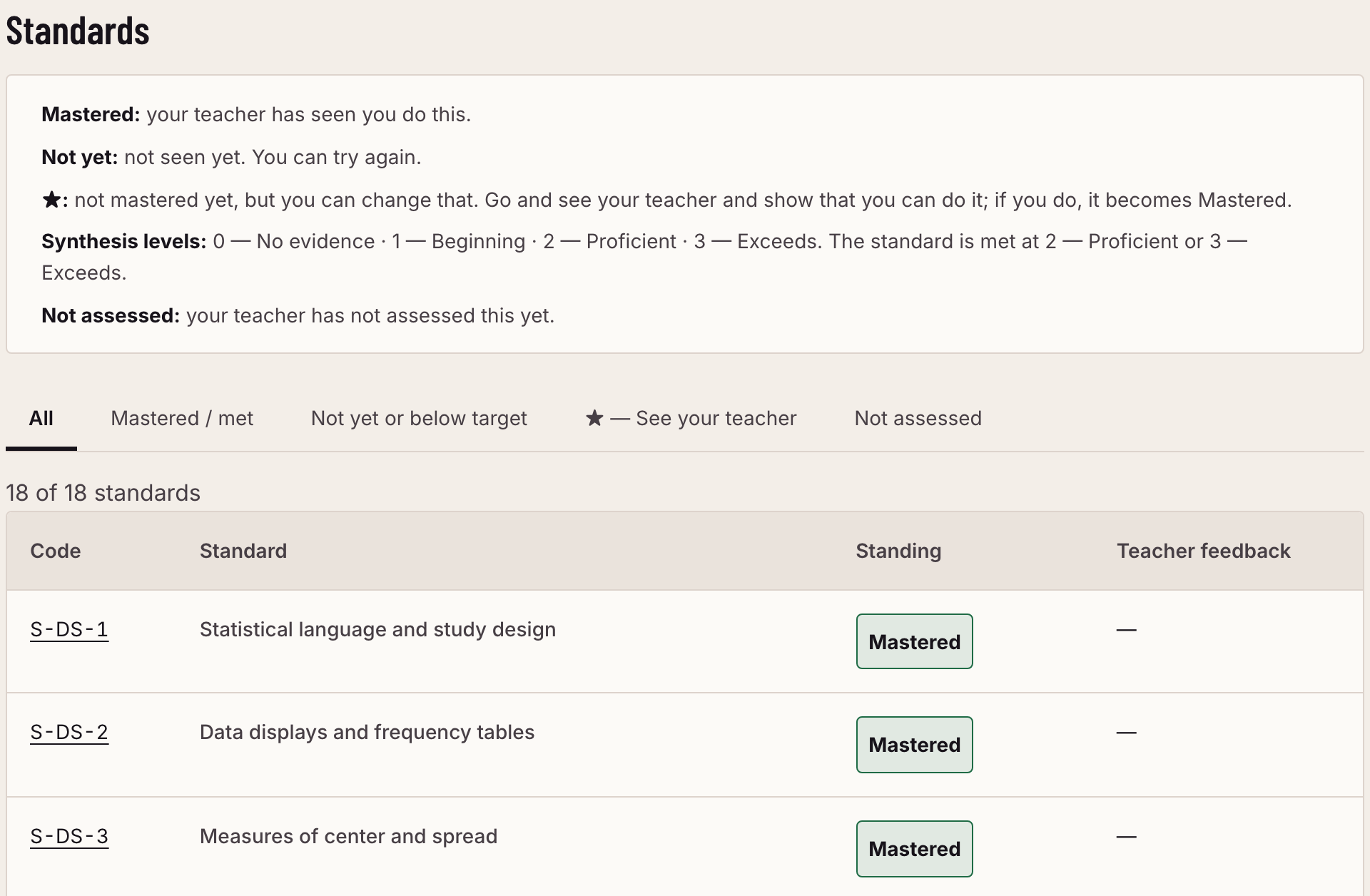
You can tell what is official: the results your teacher enters for each course standard have their own page. Your practice estimates sit on another, and they do not change a result.
Why Practice is where you are supposed to be wrong; it could not do that job if it counted.
Notice the legend above the table: each word your teacher can use is defined on the page.
A fictional class: the names and numbers are invented. Tap or click a picture to see it at full size.
What to prepare for the next class
“Read the next section” said at the end of a class is easy to lose.
What it does, and why
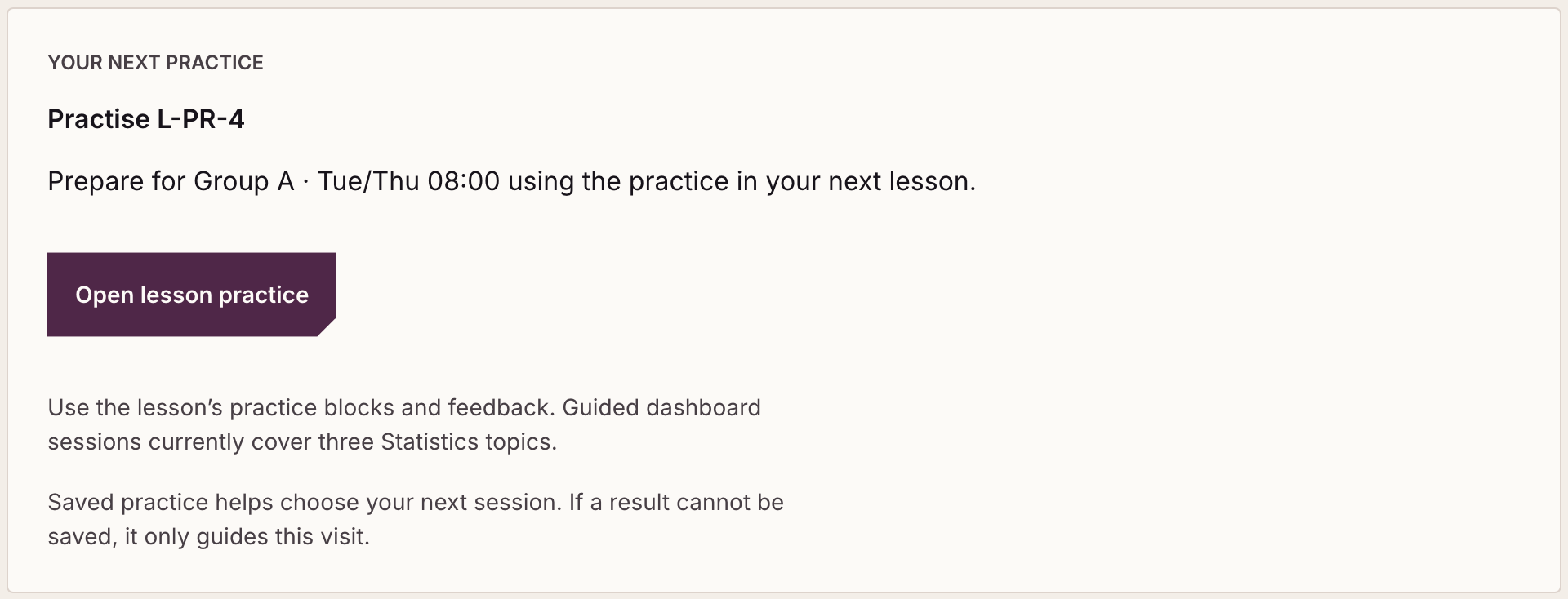
You arrive knowing what is next: your teacher chooses the next lesson and can share preparation with the class. It appears on your dashboard beside the class.
Why Arriving prepared changes what a class can do with its time.
Notice it names the lesson to prepare for your next class, and offers one button.
A fictional class: the names and numbers are invented. Tap or click a picture to see it at full size.
One question after class
You left the class unsure and nobody knew, including you.
What it does, and why
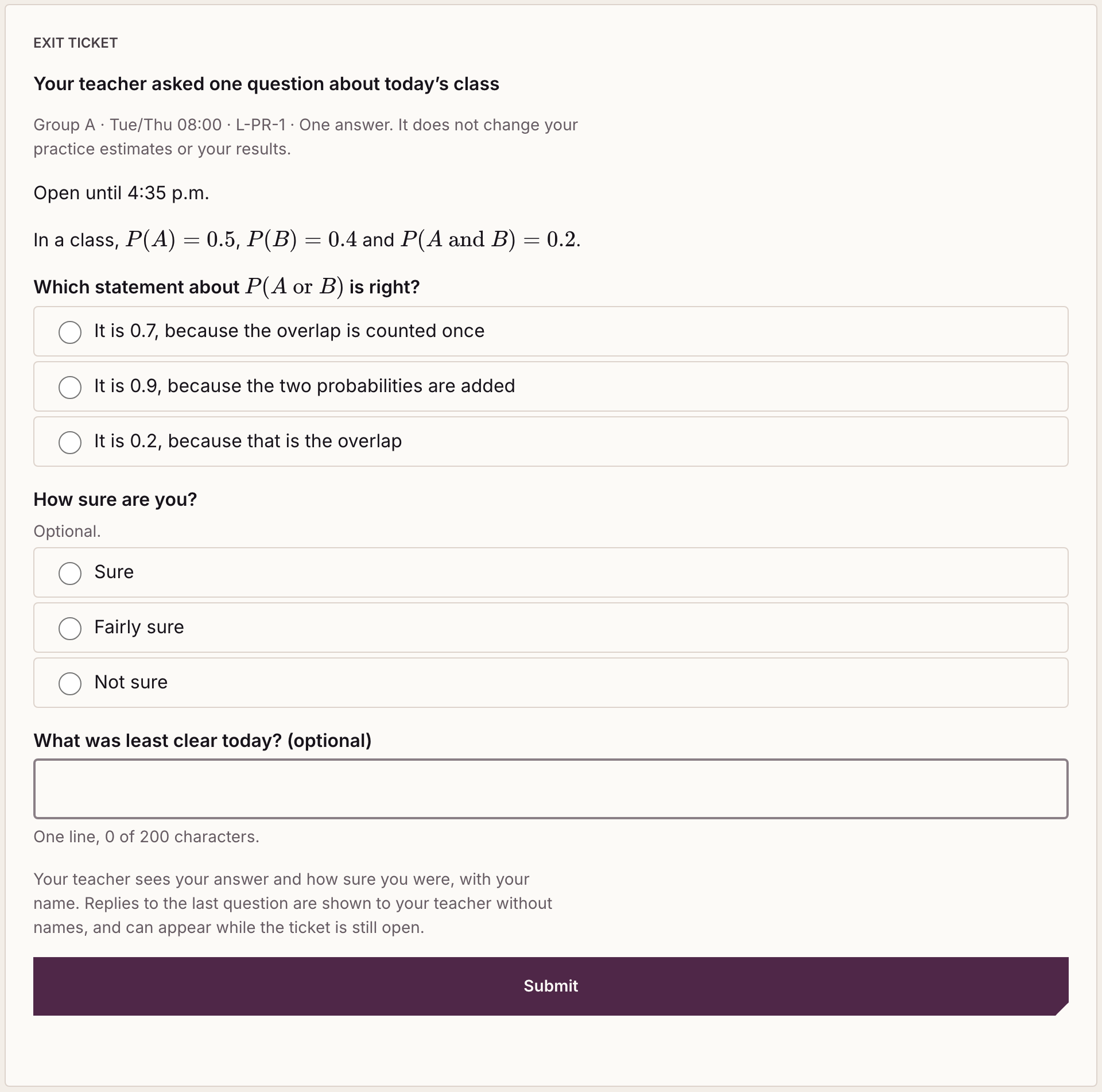
You see the same day how you did on today’s idea: your teacher can open a single question about the lesson, sometimes called an exit ticket. You answer once, can say how sure you are, and can say what was least clear.
Why Your teacher sees, with your name, whether you answered, whether you were right and how sure you were, so that they can help. What you write about what was least clear is shown without names, though a teacher watching replies arrive may be able to tell who wrote one. It does not change a result or a practice estimate.
Notice the line above Submit. It says “your answer”; by name, your teacher sees whether you were right and how sure you were, not which option you chose.
A fictional class: the names and numbers are invented. Tap or click a picture to see it at full size.